 Watt
WattGenerators for EV charging
I own one generator. I'm not going to pretend I've bench-tested a dozen — instead, here's the spec checklist that actually determines whether a generator can charge a car, and the one unit I can speak to firsthand.
The five specs that decide it
| Spec | What you need | Why |
|---|---|---|
| Inverter output | Yes, under 5% THD | Onboard chargers reject dirty power; conventional units run 15–25% |
| 240V receptacle | 14-50R or L14-30R | 120V works but crawls at ~4 miles per hour |
| Running watts | 6,000W minimum | Below this you're derated into 16A territory |
| Neutral bonding | Bonding plug included | Otherwise it faults out of the box |
| CO shutoff | Non-negotiable | Portable generators kill people every year |
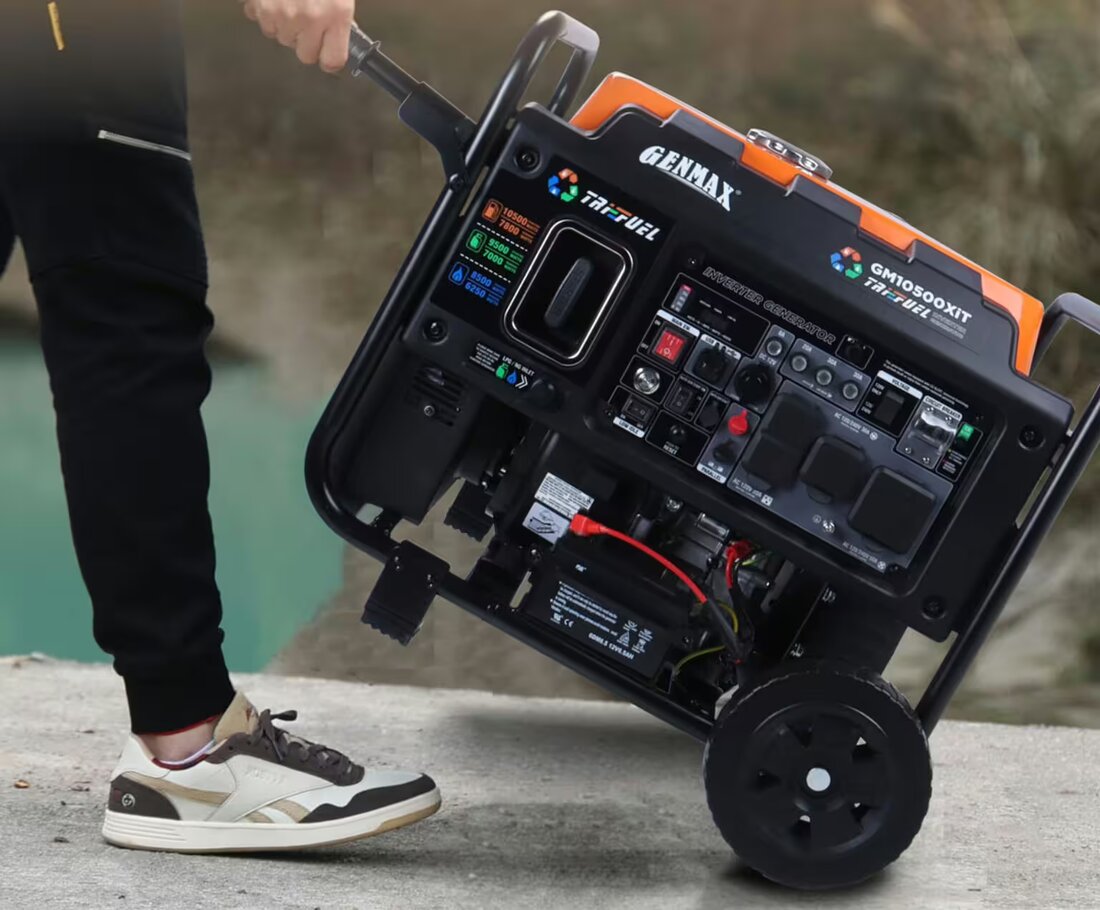
GENMAX GM10500XiT
✓ Owned, running, and the source of every number on this site
Open-frame tri-fuel inverter. It hits all five criteria, which is genuinely uncommon at this price, and it's the reason I could write the bonding guide from experience rather than theory.
- 7,800W running on gasoline (10,500W peak) — 24A charging with real headroom
- Under 3% THD — clean enough for the onboard charger without argument
- 14-50R and L14-30R — charge from one, bond the other
- Tri-fuel — gasoline, propane, natural gas, with the output penalties I've measured
- Bonding plug included — the detail almost nobody advertises
- CO sensor with shutoff, electric and remote start
The tradeoffs: open-frame means louder than an enclosed inverter, and it's heavy enough that moving it is a two-person job on anything but flat ground. At 24A it burns roughly half a gallon per 10 miles of range added — generator charging is never cheap, just available.
Check priceInverter is not the upgrade tier, it is the entry requirement. A conventional generator at any wattage is the wrong tool here. Why →
Sizing down
If 7,800W is more generator than you want, the honest floor for practical 240V charging is around 6,000W running. Below that, run the numbers in the calculator before you buy — a 3,500W unit charges at about 10 miles per hour in good weather and roughly 6 in the cold, which for many people isn't worth the fuel.
Not tested here
Plenty of other units meet the checklist above — open-frame inverter models from several manufacturers land in the same range. I haven't run them, so I'm not going to rank them as though I have. Use the five specs as your filter and you'll sort the field yourself. When I test more, they'll appear here with measurements attached.