 Watt
WattYour generator won't charge your EV. Here's the $20 reason.
You plug the charging cable into the generator. A light blinks red. Nothing happens. The generator is fine and the car is fine — the neutral isn't bonded.
What's actually happening
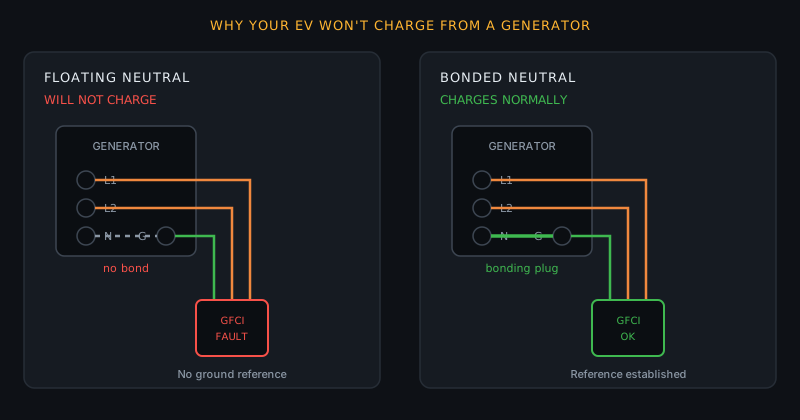
Every EV charging cable has ground-fault detection built in. To test for a fault, it needs a stable reference between neutral and ground. In a house, your main panel bonds those two together at exactly one point, so the reference exists.
Most portable generators don't. They ship with what's called a floating neutral — neutral and ground are isolated from each other. This is deliberate: it's the correct configuration when the generator feeds a house through a transfer switch, because the house panel already provides the bond, and a second bond would create a dangerous parallel path.
But standing alone in a driveway, a floating-neutral generator gives the charging cable nothing to measure against. The cable interprets that as a fault and refuses to energize. It is doing its job.
The fix
Install a neutral bonding plug — a plug body that jumps neutral to ground inside an unused receptacle on the generator. That single connection gives the charging cable its reference, and the fault clears. Some generators include one; most don't.
How to know which one you have
Check the manual first — manufacturers state it, usually under specifications or the transfer switch section. If you don't have the manual, a multimeter settles it in ten seconds:
- Generator off.
- Set the meter to continuity or lowest resistance.
- Probe the neutral slot and the ground pin of any 120V receptacle.
- Near-zero ohms or a beep means bonded. Open circuit means floating.
My unit: GENMAX GM10500XiT
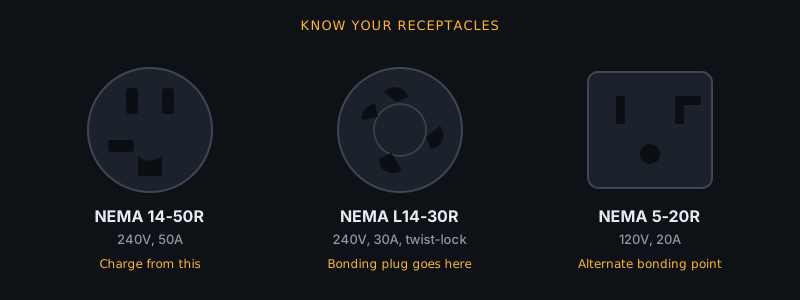
Mine shipped with a twist-lock bonding plug in the box. It seats in the L14-30R receptacle, which leaves the 14-50R free for the charging cable — a genuinely well-thought-out arrangement that not every manufacturer bothers with. Installed and verified: the Mobile Connector energizes with no fault.
If yours didn't include one, a bonding plug is roughly $15–25 and matches whichever receptacle you're leaving unused. Get the one that fits your generator's open outlet, not the one you're charging from.
Critical: pull the plug before you feed the house
If your generator can also back-feed your home through a transfer switch, the bonding plug must come out first. Your main panel already bonds neutral to ground. Adding a second bond at the generator creates two parallel neutral-ground paths, puts current on equipment grounding conductors, and can defeat GFCI protection downstream.
Plug in for standalone EV charging. Plug out for transfer-switch house feed. Unless your transfer switch is a true four-pole unit that also switches the neutral — in which case the generator is a separately derived system and the bond stays. Check your switch before assuming.
Drop the file at
/assets/bonding-plug-installed.jpg and swap this block for a <figure>.Still faulting after bonding?
| Symptom | Likely cause |
|---|---|
| No 240V at the 14-50R | Voltage selector switch left in 120V-only mode |
| Charges briefly, then drops | Amperage set too high; generator hits overload protection |
| Fault returns intermittently | Extension cord too long or undersized — voltage sag under load |
| Fault on a non-inverter generator | Total harmonic distortion too high; onboard charger rejects dirty power |
That last one matters when shopping. Conventional generators can run 15–25% THD. Inverter generators hold under 3%, which is why they're the only category I'd put in front of an EV's onboard charger.
Next: work out a safe charging amperage for your generator →